



Modern maritime operations demand a high level of operational awareness, precision, and coordination among crew members. Navigating vessels through busy ports, offshore environments, and complex shipping routes requires professionals who are well-trained in ship handling, navigation systems, and decision-making.
Bridge simulators are essential in training maritime workers to handle such operational situations. The simulation systems also enable maritime officers and crew to rehearse navigation processes, ship management, and coordination in the real maritime environment before they undertake the tasks in the real environment.
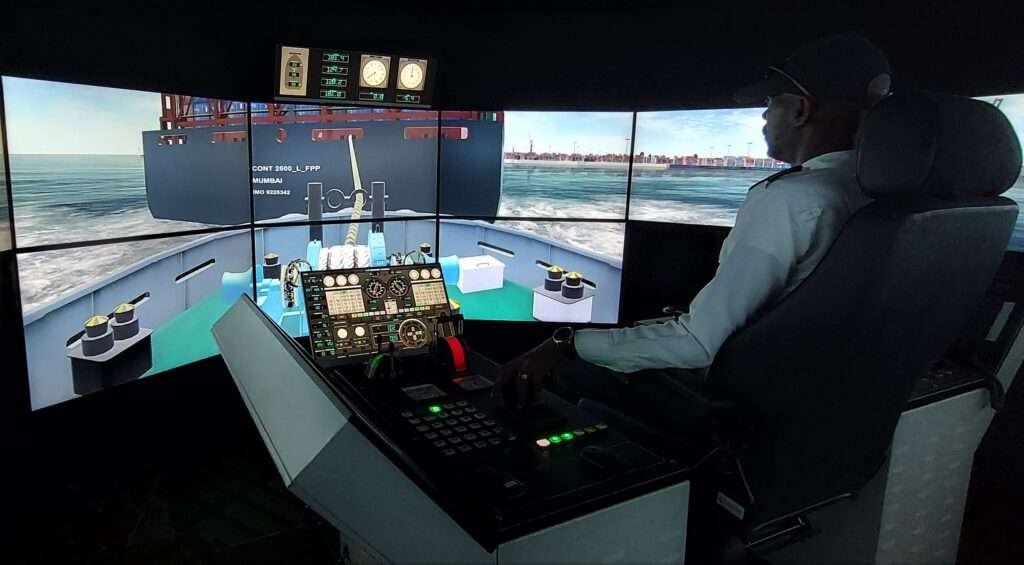
The future of maritime training facilities lies in maritime training simulators. These modern systems meet international maritime standards, including IMO and STCW training requirements, and include DNV-GL Class A certified maritime training products that ensure realistic and compliant training environments.
Maritime training simulators are designed to work as modular systems, which means that training facilities can be expanded when the operational demands increase. The environments can simulate real ship equipment, machinery, vessel behavior, and geographic operating conditions. They are generally provided as turnkey systems, with design services, build services, and installation services to both enterprises and defense facilities and training centers.
Key features of maritime training simulators include the following:
Modern maritime training simulators provide a wide range of capabilities that enhance training efficiency and operational learning. These systems support both instructors and trainees by providing flexible training environments and detailed performance evaluations.
Customized Simulation Solutions
Simulation systems can be tailored to meet specific training requirements. Maritime institutions can replicate their vessels, operational environments, and equipment to create realistic training scenarios.
Virtual Reality Training Environments
Adaptable virtual reality modes allow trainees to experience real-life operational situations in a controlled and risk-free environment. These environments enable trainees to experiment with different navigation strategies and operational procedures.
Immediate Feedback and Performance Review
Simulation platforms allow instructors to monitor training exercises and provide immediate feedback based on actions and decisions taken during the session.
Flexible Training Modules
Online simulation sessions can be conducted without restrictions on the number of participants. This allows training institutions to conduct collaborative training exercises involving multiple trainees.
Multi-Trainee Simulation Platforms
Training facilities can deploy multi-trainee simulators ranging from custom-built vessel simulations to complex mission-specific training environments.
STCW training simulators are widely used to support navigation training programs in maritime institutions. These simulation systems allow trainees to practice vessel navigation and bridge operations through structured training scenarios.
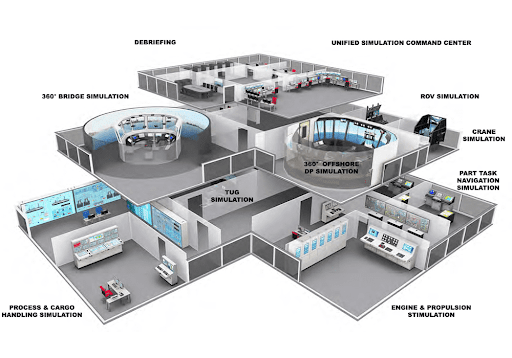
Maritime navigation simulators are available in a wide range of configurations, from tabletop and part-task trainers to large-scale installations with a 360-degree field of view. These simulators create immersive training environments with integrated visual displays, navigation instruments, and operational controls that closely replicate the bridge of a real vessel.
The Full Mission Ship Handling Simulator
The Full Mission Ship Handling Simulator is a complete bridge structure where trainees are exposed to vessel navigation and vessel maneuvering in real maritime conditions.
Full Mission Tug Simulator
The Full Mission Tug Simulator allows trainees to train in executing operations and maneuvering of tugboats that involve a high level of control and coordination. The simulator is capable of simulating complicated tug maneuvers in different environments to enable trainees to acquire accurate vessel handling skills in real situations.
RADAR / ARPA / RANSCO Simulator
This simulator provides training on radar navigation and collision avoidance systems, allowing trainees to interpret radar data and manage vessel traffic scenarios.
ECDIS Simulator
The ECDIS simulator allows trainees to practice electronic chart navigation using digital maritime charts and navigation tools integrated within the simulation environment.
GMDSS Simulator
The Global Maritime Distress and Safety System simulator supports training related to maritime communication systems used for distress alerts and operational communication. The simulator replicates the communication systems used on modern vessels, enabling trainees to practice distress alerts, safety communications, and routine maritime communication procedures.
Steering and Mini-Bridge Simulator
The Steering and Mini-Bridge Simulator provides compact training environments that allow trainees to practice essential bridge operations and vessel steering tasks.
Besides training in navigation, maritime simulation environments have dedicated marine engineering training simulators. Engineering simulators are multi-purpose training systems that facilitate the training of marine engineers in watchkeeping, operations, and management.
Key engineering simulation systems include:
Full Mission Engine Room Simulator
This simulator replicates the operational environment of a ship’s engine room, allowing trainees to understand machinery systems and operational procedures.
ERS Simulator
Engine Room Simulator platforms help engineers practice monitoring and managing vessel machinery during different operational conditions.
High Voltage Simulator
High-voltage simulators support training related to electrical systems and power management on modern vessels.
Liquid cargo handling involves specialized operational expertise because of the risks that may be encountered when handling bulk liquids between land operations and ocean operations.
Liquid and Process Cargo Handling Simulators imitate real-time process flow control systems in cargo storage and transfer processes. These simulators will enable the trainees to train on routine operations as well as emergency scenarios where there is a transfer of hazardous bulk liquids.
Field exercises with these systems help crews learn to understand the working process, the reaction of the system, and some safety measures related to cargo transfer operations.
Some maritime processes entail specialized equipment, including cranes and fishing systems. Crane and Fishing Simulators exist to simulate the appearance, behavior, and operation of these equipment systems.
Crane simulators are devices that replicate the workings of various crane models while keeping the controls user-friendly and easy to understand among the trainees and the instructor. Those systems enable the operators to train in handling loads and operating equipment in simulated maritime conditions.
Fishing simulators assist in training associated with fishing activities and ship materials management. Simulation training enables operators to have practical experience prior to undertaking actual maritime activities.
Offshore operations present unique challenges that require specialized training environments. Offshore simulator suites are designed to support training, competency assessment, and skill development for professionals working in offshore maritime industries.
These simulators can be deployed for a variety of purposes, including:
The offshore simulator suite includes several specialized simulation systems.
DP Class A/B Simulator (NI Guidelines)
This simulator supports training related to dynamic positioning operations.
AHTS Tug Simulator
The AHTS simulator supports training for anchor handling tug supply vessels used in offshore operations.
ROV / Subsea Simulator
This simulator supports subsea operations involving remotely operated vehicles.
Drilling Simulator – Surface Tool & Downhole Operations
Drilling simulators replicate surface and downhole drilling operations used in offshore energy environments.
Bridge and maritime training simulators are critical in ensuring that the maritime professionals are ready to deal with the operational challenges they might face at sea. These systems can also facilitate realistic experiences in the learning process by simulating the environment of real vessels and encouraging real-time use of the latest navigation systems, which enhance operational knowledge and technical capability. KDU is providing state-of-the-art maritime simulation solutions to support the maritime training centers, defense organizations, and industry operators in building a well-prepared training environment that will assist in the safe and efficient operations of vessels. At KDU World, the mission is to assist maritime operators through efficient equipment and good training solutions. KDU assists shipping companies to enhance crew skills and enhance the safety of navigation with sophisticated bridge simulator facilities that meet the requirements of a modern vessel and real-life operation.