
September 29, 2026
Blogs
In contemporary shipping practices, precise quantification of vessel speed and motion is no longer a mere navigational convenience but an element of operational effectiveness, safety, and regulatory adherence. Ensuring accurate docking maneuvers and fuel optimization processes to aid enhanced AI-driven navigation systems and autonomous vessels, reliable speed data is a necessity. The NAVIKNOT Speed Log System by Sperry Marine is a solution to these needs, since it offers a high-precision and multi-sensor solution that can serve a diverse range of ships, from luxury yachts to large commercial carriers, and make marine operations safer, smarter, and efficient.
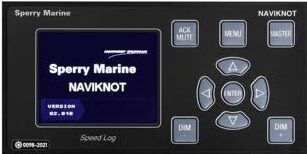
The NAVIKNOT Speed Log System is a family of instruments used to compute Speed Through Water (STW) and Speed Over Ground (SOG). Designed by a renowned marine navigation company, Sperry Marine, the NAVIKNOT series represents a range of models appropriate for most ships and operating situations.
The NAVIKNOT series utilizes new technology to ensure reliability and accuracy in different maritime operations. Its modular design allows it to accommodate various sensors and configurations, making it highly versatile for different classes of vessels.
Multi-Sensor Technology
The NAVIKNOT system employs a combination of sensor technologies to offer accurate speed measurement:
High Accuracy
With ±1% or 0.1 knot speed accuracy, the NAVIKNOT system ensures precision, which is crucial during docking and navigation.
Two-Axis Measurement
The latest models, like the NAVIKNOT 600 series, have two-axis reading, measuring along the length and width for speeds. This proves useful for docking operations, providing broad speed information.
Intuitive Display
The system boasts a large color TFT display, which provides unambiguous distance and speed readings. It has both day and night modes, a mile counter, and the capability to perform docking maneuvers by presenting the necessary information.
Simple Installation and Integration
It is easy to install and integrate with installed vessel navigation and bridge systems with low downtime for retrofits.
Broad Vessel Compatibility
From pleasure boats to oil tankers, the NAVIKNOT system can be applied to a broad range of ships, presenting a generic solution for all types of maritime operations.
NAVIKNOT systems are not only essential for navigation but also crucial for other marine operations. They are accountable for safety, improving efficiency, and introducing new technologies for intelligent maritime administration.
Ship Operations
Autonomous Ships: Provides accurate speed data required by AI-driven navigation and dynamic positioning systems.
Predictive Maintenance: Facilitates harvesting of operating data for failure prediction to allow preemptive maintenance and minimize downtime.
Navigation: Enables efficient route planning and fuel optimization through offering consistent speed measurement.
Port & Logistics
Port Management: Supports efficient management of containers and optimizes port facility operation.
Supply Chain Management: Synchronizes order management to logistics and inventory information, streamlining shipping processes.
Cargo Optimization: Assists in cargo loading and unloading optimization by synchronizing weight, volume, stability, and port infrastructure information.
Safety & Security
Maritime Safety: Assists collision avoidance systems and traffic control systems like Vessel Traffic Service (VTS).
Cybersecurity: Protects maritime systems from unauthorized access and cyberattacks through secure data transfer.
Maintenance & Management
Crew Management: Computer software helps manage crew payroll, crewing, and other administrative tasks.
Compliance Tracking: Vessel maintenance and compliance tracking software packages.
Smart Shipyards: Software packages that enable improved designing, constructing, and managing newbuild ships.
Emerging Technologies
Alternative Marine Fuels: Enables cleaner fuel transition by providing quality speed data required for fuel optimization.
Digitalization & Mobile Apps: Enables improved communication and data exchange between shore-based staff and seafarers.
Dredging & Surveying: Optimizes the precision and efficiency of dredging operations and underwater object position.
Keep Reading